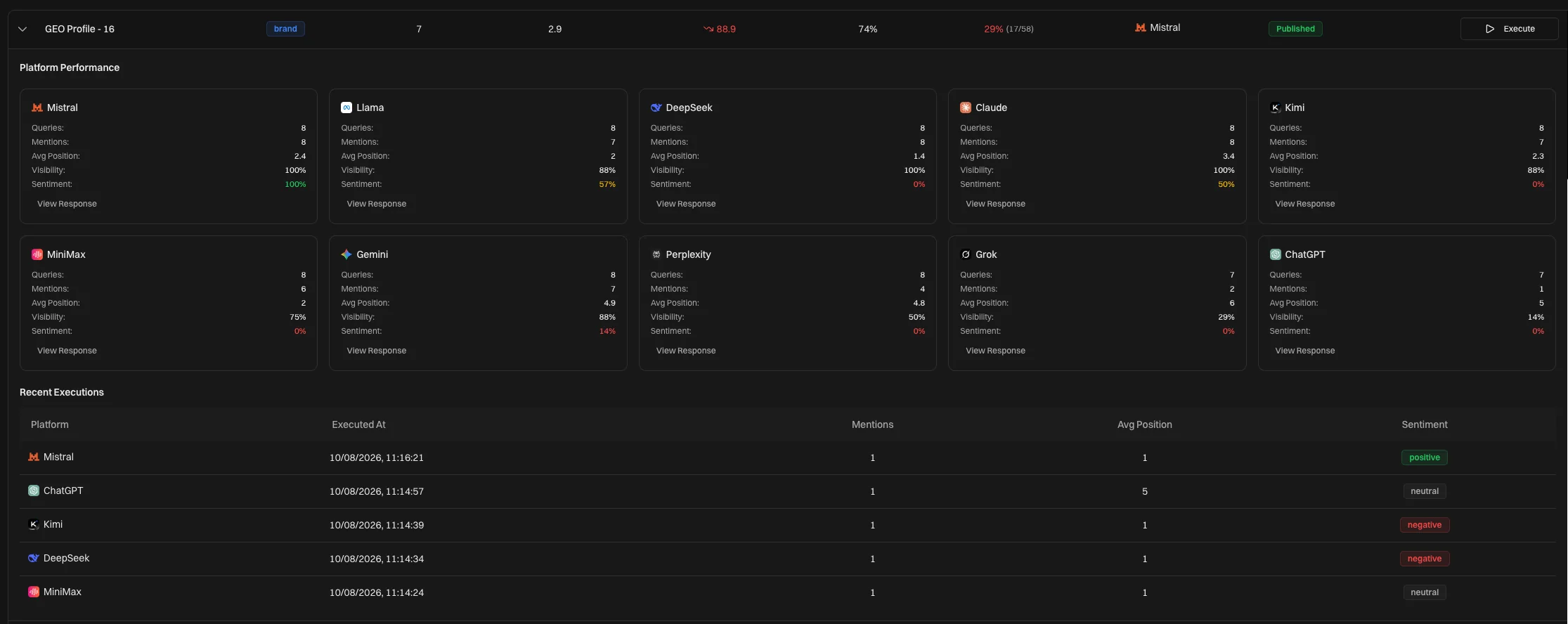
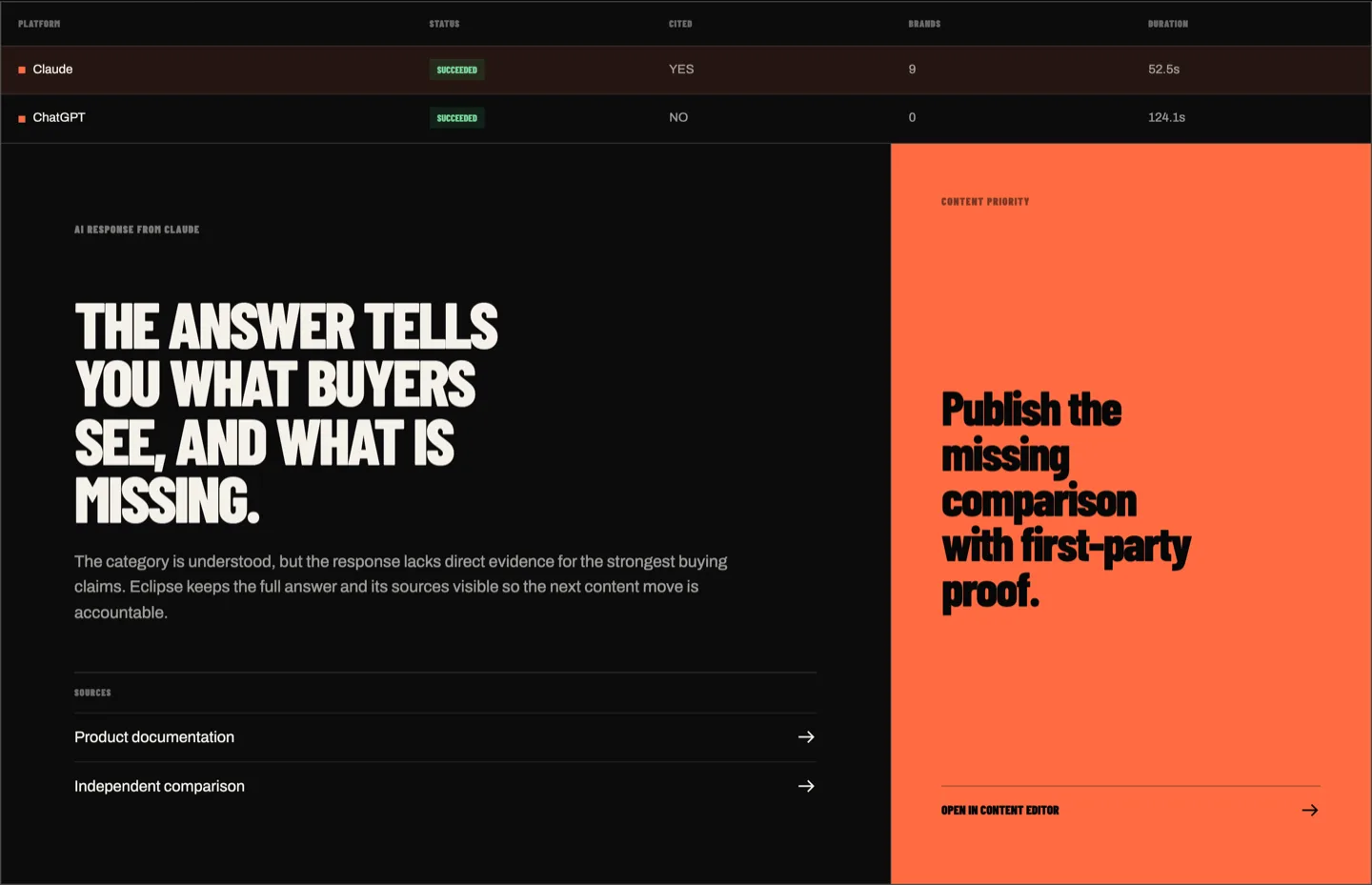
A score tells a client where they stand. An evidence pack shows them why, and holds up when they ask. Fixed prompts, the raw answers from ChatGPT, Claude, Gemini and Perplexity, and the same competitors measured on the same questions.
ALL PROFILESPUBLISHEDDRAFTEXPORT CSV
PROFILE NAMETYPERUNSMENTIONS
Prove AI visibility with evidenceproblem10
PLATFORM PERFORMANCE
ChatGPTQueries1Mentions0Last run21/09, 12:59
ClaudeQueries1Mentions0Last run21/09, 12:58
GeminiQueries1Mentions0Last run21/09, 12:58
PerplexityQueries1Mentions0Last run21/09, 12:58
Best content ops software for agenciescategory10
Auditable AI visibility claimsproblem10
Best GEO tools for agenciescategory10
Alternatives for agenciescompetitive10
FIXED PROMPTS · RAW ANSWERS · THE SAME COMPETITORS ON THE SAME QUESTIONS✦FIXED PROMPTS · RAW ANSWERS · THE SAME COMPETITORS ON THE SAME QUESTIONS✦FIXED PROMPTS · RAW ANSWERS · THE SAME COMPETITORS ON THE SAME QUESTIONS✦FIXED PROMPTS · RAW ANSWERS · THE SAME COMPETITORS ON THE SAME QUESTIONS✦FIXED PROMPTS · RAW ANSWERS · THE SAME COMPETITORS ON THE SAME QUESTIONS✦FIXED PROMPTS · RAW ANSWERS · THE SAME COMPETITORS ON THE SAME QUESTIONS✦
CHATGPT · CLAUDE · GEMINI · PERPLEXITY · DEEPSEEK · LLAMA · MISTRAL · KIMI · MINIMAX · GROK✦CHATGPT · CLAUDE · GEMINI · PERPLEXITY · DEEPSEEK · LLAMA · MISTRAL · KIMI · MINIMAX · GROK✦CHATGPT · CLAUDE · GEMINI · PERPLEXITY · DEEPSEEK · LLAMA · MISTRAL · KIMI · MINIMAX · GROK✦CHATGPT · CLAUDE · GEMINI · PERPLEXITY · DEEPSEEK · LLAMA · MISTRAL · KIMI · MINIMAX · GROK✦CHATGPT · CLAUDE · GEMINI · PERPLEXITY · DEEPSEEK · LLAMA · MISTRAL · KIMI · MINIMAX · GROK✦CHATGPT · CLAUDE · GEMINI · PERPLEXITY · DEEPSEEK · LLAMA · MISTRAL · KIMI · MINIMAX · GROK✦
Why a score alone does not survive the meeting
A visibility score is one number standing in for hundreds of answers. It is the right thing to open a client review with and the wrong thing to defend one with.
The number arrives without its working
Somebody asks which questions produced it. If the only answer is a dashboard, the conversation turns into trust rather than evidence.
The prompts move between runs
Change the questions and the score changes with them. Without a locked set, this month and last month are not comparable and neither is the story you tell about them.
The work leaves with the person who ran it
When the account changes hands what transfers is a slide. The reasoning stays with whoever did it.
What counts as evidence
A pack is complete when somebody who was not in the room can repeat the run and get the same shape of answer.
A fixed prompt register
The questions are written down per client and do not change between runs without a note saying why.
A stated cadence
Weekly, monthly, or before each review. The period is labelled on every result.
Raw answers, not summaries
The full response each platform gave, kept as it came back.
Mention, citation and recommendation kept apart
Being named, being linked and being put forward are three different outcomes, and a pack counts them separately.
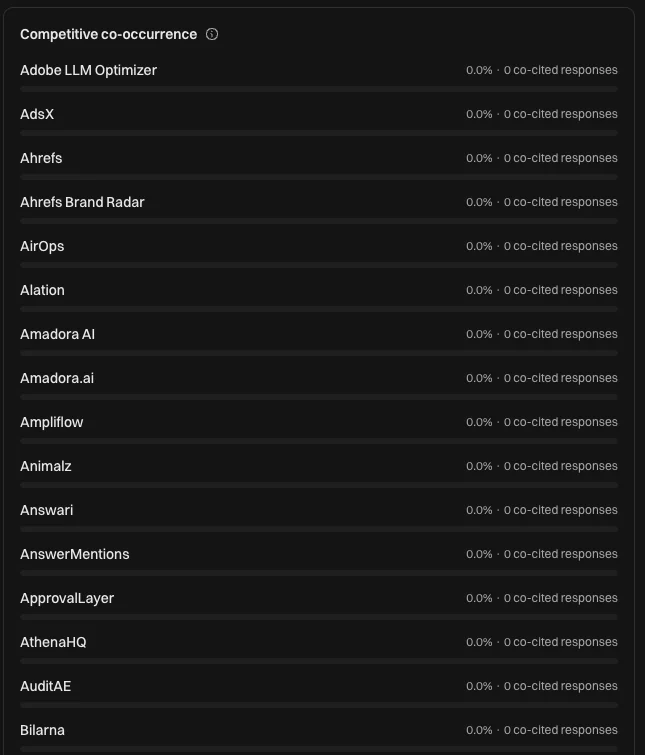
The same competitors on the same questions
A comparison means something only when both brands were asked the same thing on the same day.
Platform and period on every figure
Every number carries which engine produced it and when.
The method
Six steps an agency can run, sell and hand over.
Lock the prompt register
Write the questions a buyer would actually put to an assistant. Agree them with the client and freeze them.
Choose platforms and cadence
Decide which engines matter for this brand and how often to ask. A smaller set asked often beats every engine asked once.
Capture the raw answers
Keep the full response rather than a summary of it. The answer is the evidence.
Tabulate against defined metrics
Score with the definitions written down, so the next person scores the same way you did.
Compare named competitors on the same prompts
Same questions, same day, same engines. Anything else is two studies wearing one cover.
Package it for the review
Cover, method, prompts, results by platform, competitor table, caveats, next actions.
The words, defined
Agree these with the client before the first run, not after the first challenge.
Mention
The brand appears in the answer by name.
Citation
The answer links to the brand's own page as a source.
Recommendation
The answer puts the brand forward as an option rather than naming it in passing.
Presence rate
The share of prompts in the register where the brand appeared at all, on one platform over one period.
Share of voice
How often the brand appeared against the named competitor set, on the same prompts.
Recommendation rank
Where the brand sat in the order when an answer listed options.
What a client pack contains
An example structure rather than a report Eclipse has published.
CLIENT PACK
Cover
Client, period, platforms, and who ran it.
Method
The prompt register, the cadence, and what was counted.
Results by platform
Each engine on its own, because they do not agree with each other.
Competitor table
The named set, measured on the same prompts.
Caveats
What the run could not see, and what changed since the last one.
Next actions
The gaps worth writing against, in the order worth writing them.
Where Eclipse fits, and where it does not
Some of this is product and some of it is how an agency chooses to work. The split matters when you are selling it.
GEO profiles hold the register
Generative engine optimisation profiles carry the buyer questions, the competitor brands and the platforms to scan. That is the locked set the method asks for.
Runs are weekly or on demand
Profiles run on a weekly schedule or when you run them, and usage follows the platforms you pick.
Logs keep the raw answers
Each run is recorded by profile, platform, date, status and mention count, and opens to the full response so you can copy it into a client pack.
Competitors are named and discovered
You set the competitor brands. Eclipse also surfaces others that keep appearing alongside the client.
Client workspaces stay separate
Every client is its own workspace, so one client's register and history never appear inside another.
The pack itself is yours
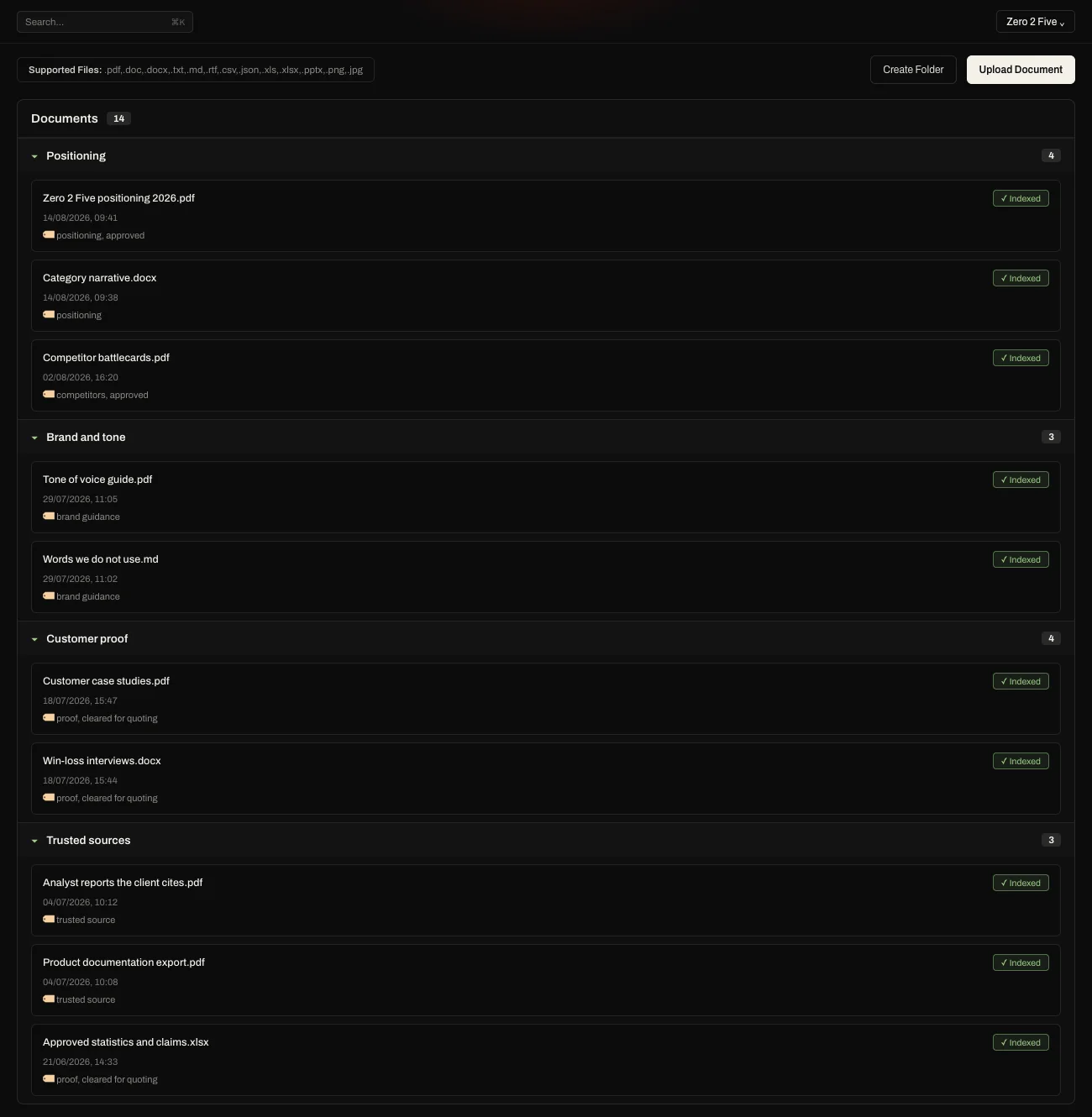
Eclipse holds the runs, the answers and the history. Assembling them into a client document, and the language used in it, is agency work.
THE PACKWHO OWNS WHAT
The runsEvery profile, on every platform you pickedECLIPSE
The raw answersKept as each engine returned themECLIPSE
The historyWhat moved between one run and the nextECLIPSE
The documentThe pack a client actually readsYOU
The languageHow the findings are written downYOU
The recommendationWhat you tell them to do nextYOU
THE EVIDENCE IS THE PRODUCT. THE PACK IS AGENCY WORK.
Common questions
No. A score is the right opening line for a review and a poor closing argument. Lead with it, then show the pack behind it.
Often enough that two runs can be compared, rarely enough that the client sees movement rather than noise. Weekly suits a brand that is actively publishing and monthly suits most others.
The ones a client's buyers actually use. Eclipse can query ten, and ChatGPT, Claude, Gemini and Perplexity cover most B2B buying research today.
That is a result rather than a failure of the method. A register that comes back empty tells you which questions to write against, and it is the baseline the next run is measured from.
This page is the method that produces the evidence. Auditability is what keeps it defensible through approval, staff change and handover.
PROVE IT ON A CLIENT YOU ALREADY RUN
Bring one account and a handful of the questions their buyers ask. We will set the register up on the call.
 ChatGPT
 Claude
 Gemini
 Perplexity