
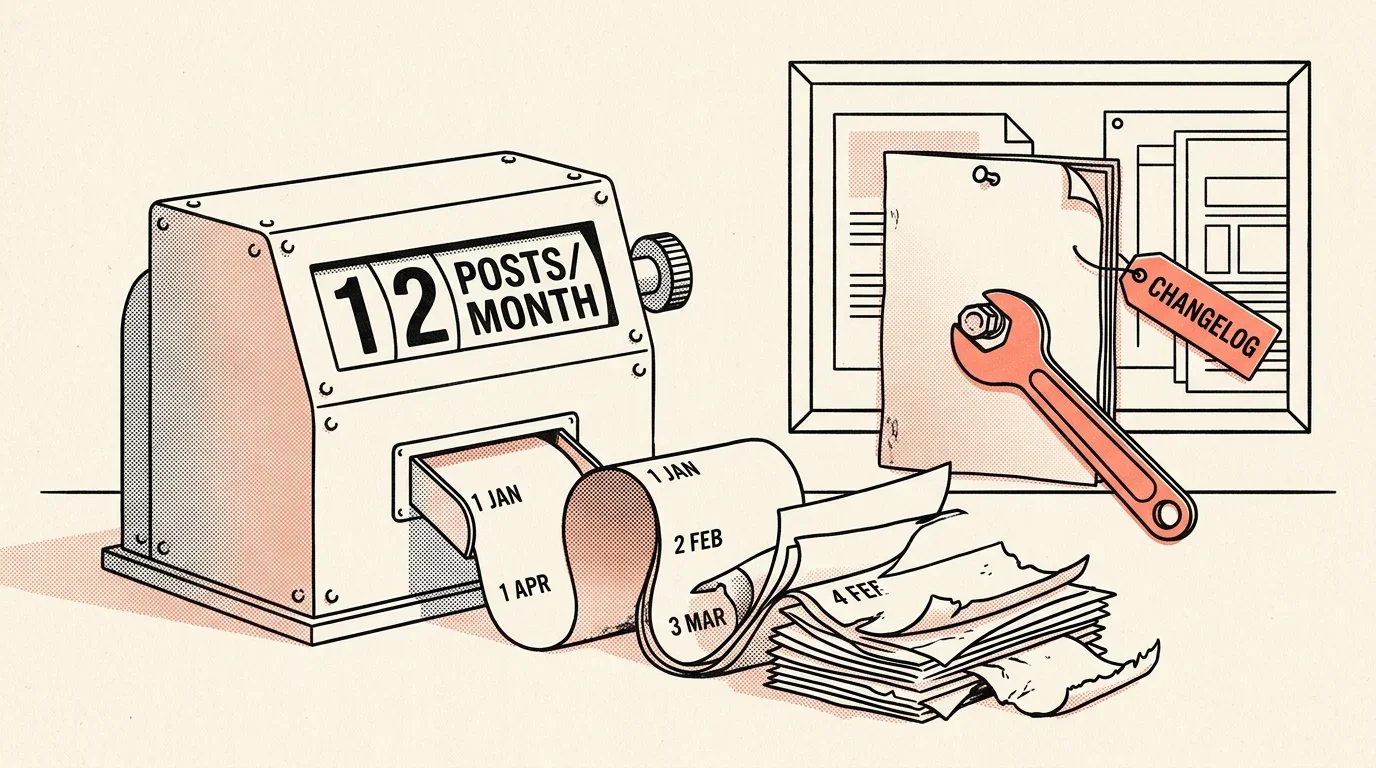
If your CMO has asked for twelve new posts a month, you're holding a production target that's been given the job of an AI visibility strategy. This article is for B2B content and SEO leads who have to accept that number or bring back a better plan. It also covers what an AI visibility platform should measure before you trust it, because a weekly score that jumps around won't survive a CMO who thinks in pipeline.
Here's the argument. Steady, evidence-bearing work on the pages buyers already rely on beats bursts of new output. The controlled experiments behind AI search visibility got their gains by editing what sat on a page. Nobody has published an experiment showing that posting cadence causes a brand to appear in AI answers.
A quota measures effort. Engines reward something else. They reward pages that answer a buyer's question with proof, and other sites that agree with them. The rest of this article gives you criteria your SEO specialist can use this month and wording your CMO can say yes to.
Why has a weekly quota become your AI visibility plan?
A quota becomes the plan because it's the easiest number to count. Posts per month fits on a slide, and a CMO from demand generation can check it every Monday. The experiments behind AI visibility point somewhere else. They improved results by changing page content, and none of them treated publishing frequency as the lever.
The study that coined the term GEO came out in late 2023. Its authors took existing pages, edited in additions such as citations, quotations and statistics, and then measured whether generative engines surfaced those pages more often [1]. Every variable they tested lived on the page.
The company case results tell the same story. Folloze earned independent coverage. Popl reworked existing content and tracked the leads it produced. Spot AI built pages around specific buyer questions. Each one describes a change to content, monitoring or outside mentions. None of them compares a weekly schedule with a page someone kept accurate.
Quotas survive because volume is visible and upkeep isn't. Twelve posts a month adds 144 URLs a year, and every one of them needs an owner when the facts change. If you run content for payroll or HR software, you already know which pages go stale first. It's the compliance and multi-state tax pages sales sends to prospects, and they break every time a regulation moves.
Pull writers off those pages to hit a count and you swap your most trusted URLs for unproven ones. That's a bad trade. It gets worse every month the quota runs, because the backlog of pages nobody owns keeps growing quietly in the background while the pages that help close deals drift further out of date.
Why does consistency split into three separate jobs?
Consistency covers three jobs, and a quota treats them as one. Keep accurate pages retrievable. Cover each distinct buyer question properly, once. Sustain mentions on sites you don't own. Merge the three and consistency collapses into volume, because new URLs are the only output a calendar can see.
The first job is upkeep. A page engines already retrieve is worth more than a new one they've never seen, as long as its facts hold. Upkeep means checking those facts, swapping out dated evidence and adding the alternatives a buyer would weigh.
The second job is coverage. Each real buyer question deserves one strong page with its own evidence. A fourth post on the same question splits your proof across four thin pages and gives an engine four weak options to choose from.
The third job is corroboration. When an engine answers an unbranded category question, it looks for agreement across sources. Your own blog can't supply that agreement, however often it posts.
Then there's the belief that newer always wins. It doesn't. Recency matters most on questions where the facts move. A blanket refresh timer burns writer hours on evergreen pages whose facts and citation performance are still sound. An older page that gets a substantive revision can keep its citations, because the edit gives an engine something current to retrieve on a URL it already trusts. Freshness follows the query.
That gives you a first test for a refresh sprint that lifted only half its pages. Sort the pages by query type. If the winners cluster on questions where facts change, like rates, thresholds and rule updates, and the flat ones sit on evergreen how-to topics, you have a working explanation to check before you open any dashboard.
When should you refresh, add a page or seek coverage?
Refresh a page when its facts, evidence or alternatives change. Create a new page only when a different question needs different evidence. Go after independent coverage when a buyer needs someone other than you to vouch for the answer. Redating, refresh timers and templated scale look like work. They give buyers nothing new.
A refresh earns its hours when something real has moved. Rules change. Sources you cited go out of date. Competitors launch features that alter the comparison your buyer is making. Each of those changes what the buyer needs to know, so the page gets new facts, fresh proof and a dated note of what changed.
A new page earns its place when the question needs its own evidence. Test it by outlining the answer. If the honest answer reuses most of an existing page, it's a new section on that page. If it needs different sources, serves a different buyer and supports a different decision, write the new page.
Coverage earns its budget when you're missing from category answers even though your owned content is good. Folloze had a strong SEO programme and still trailed in answers to unbranded buyer questions, so it placed its brand in 12 third-party articles. Across a panel of 810 nonbranded prompts on eight AI platforms, its answer presence rose from about 20% to a 41.3% peak between late February and the end of June this year, roughly doubling in four months [2]. Those figures come from the coverage provider's own write-up, so treat them as reported.
Kristi Tutt, ABM & DMM at Folloze, called it “the first mention program in our company's history, run with near-zero marginal effort from a lean team.” That's your case for moving leftover tracker money into placement. One more owned post repeats your claim. An independent article tells an engine that someone else agrees with it.
Three habits waste the hours this lens saves. Changing a date without changing the substance, refreshing everything on a fixed timer and producing templated pages at scale all pass for consistency. Google's guidance on helpful content asks whether you change dates to make pages seem fresh, and whether you produce lots of content across topics hoping some of it performs [3]. It lists both as warning signs of content made for search engines first.
Doesn't frequent publishing signal an active brand?
Fair objection, and it has a real core. Buyers and engines both notice when a brand goes quiet, and frequency is one way to stay present. It's also the most expensive way. Nobody has published a validated comparison of weekly topic clusters against one maintained pillar, so the claim that cadence builds authority rests on habit.
(It's a fair worry. Most of us learned content on calendars built around it.) The cost shows up a year later. A burst of 144 posts leaves 144 pages to maintain, and the team that wrote them is busy writing the next batch. The first batch drifts. An outdated figure on one of those pages does more harm than a missing page, because an engine can quote it back to your buyer.
Steady, justified work answers the same worry for less. Update a compliance page within days of a rule change and you show activity on the exact topic buyers care about. A dated changelog makes that visible to readers and crawlers. Independent placements keep your name in answers your blog never reaches.
So keep the instinct and change the unit of work. Presence comes from being accurate, current where it counts and named by others. If your CMO still pushes for the count, ask which of last year's posts sales still sends to prospects, and plan around those.
What should an AI visibility platform prove before you credit a refresh?
One AI answer is a poor baseline. Engines retrieve differently, their cited sources rotate faster than organic rankings, and some answers come from live search while others come from what a model learned in training. So track whether you were mentioned, cited and searched as separate outcomes, sampled repeatedly across platforms.
Mentioned means the answer names your brand. Cited means it links to one of your URLs as a source. Searched means the engine ran a live retrieval to build the answer, which is the only route by which a page you edited last week can change what it says. Training knowledge moves on the model's timetable. You can't refresh your way into it this quarter.
Build the panel before you buy anything. Twenty to thirty unbranded buyer questions is a workable size, spread across category definitions, best-of queries and head-to-head comparisons [4]. Where do you find them? Pull them from sales call notes, demo requests, support tickets and lost-deal reasons, because those carry the buyer's own wording. Keyword tools give you volume. Sales notes give you the question.
Start with the engines your buyers name on sales calls. ChatGPT, Gemini and Perplexity are where many buyers already ask for recommendations and comparisons [4]. Keep Google rankings as a separate line in your report, because Folloze's strong SEO programme didn't keep it in unbranded answers. Run each question several times on each engine, every month, and log the mention, the position and any cited URL.
Then add a control. Before you credit a refresh, pick a matching set of pages you left alone, with the same template, query type and traffic band, and compare the two groups. If both rise, the market moved, and your edit gets no credit.
Check any tool's method before you trust its trend line. Visibility scores differ between tools because each uses its own prompt panel, engines, run dates, matching rules, denominators and weights, and a composite score in the 50s can sit on a citation rate below one percent [5]. Ask the vendor for the raw component table under the headline number. Agencies need one more rule. Give each client its own panel and never rank clients against each other on a headline score, because a score only compares with others built from the same index [5].
Does AI visibility reach the shortlist and the pipeline?
Treat AI answers as one way into early consideration. If a buyer's first shortlist takes shape in a chat window, a vendor missing from it starts the deal behind. Reviews, trials and peer advice still decide who wins. So connect citations to qualified visits, then to leads, then to influenced opportunities, and treat each link as its own claim.
Keep that order, because each step answers a different question for your CMO. Citations show an engine trusts the page. Qualified visits show buyers clicked through. Leads and opportunities show whether any of it touched revenue.
Expect referral traffic to undercount the effect. After roughly doubling its answer presence, Folloze recorded 149 AI-sourced sessions across the second quarter, even with ChatGPT referrals up 133% [2]. That's a small number next to a large visibility change. Many buyers read an answer, then search your brand or type your URL days later, and analytics files that visit as branded or direct. Treat referral sessions as a floor. Keep them out of conversion forecasts.
Popl offers one of the better-attributed commercial results, because a named executive repeats it. Its case reports 38.85% monthly growth in leads from AI search after the company reworked content for AI answers and tracked AI-influenced journeys over spring 2025 [6]. Bryce Alsten, its VP of Marketing, said Popl “saw 38.85% monthly growth in leads from AI Search” and added an ROI figure whose calculation the case doesn't publish. Quote the leads. Leave the ROI out of your deck.
Check the maths on the rest. Spot AI's case reports $363,000 in influenced pipeline against $36,000 in spend and labels the result 12.9x content ROI [7]. Divide one by the other and you get about 10x. Influenced pipeline also counts opportunities the content touched, and that's a long way from closed revenue. Your CMO will do that division in her head. Do it first.
What should an AI visibility platform help you decide next?
Teams slide back to volume when monitoring, research, updates and approvals live in separate tools. Each new article starts from zero, so the only visible progress is a higher count. A useful AI visibility platform turns each month's findings into the next decision about which page to fix, which question to cover and where to earn a mention.
In most teams the tracker lives in one tab, sales questions in the CRM, source notes in a writer's document and approvals in a chat thread. When a score drops, nobody can trace which claim, page or competitor caused it. The team writes something new and hopes, and the quota looks reasonable again.
A team of five can run this loop every month without new headcount:
- Week one. Your SEO specialist runs the buyer-question panel on each engine, several runs per question, and logs mentions, positions and cited URLs in one sheet.
- Week two. The editor and SEO specialist sort every gap into refresh, new page or coverage, and check which compliance pages a rule change has made stale.
- Weeks two and three. Writers make substantive updates with a dated note of what changed. One writer prepares the facts and proof a third-party editor would need for a placement.
- Week four. Compare changed pages against the similar pages you held back, then report panel citation rate, visits and leads to the changed pages, and the opportunities they touched.
Then take a version of this to the planning meeting, adjusted to your own hours and pages:
“Publishing twelve new posts a month adds 36 pages a quarter that we'll have to maintain. Instead, we'll spend the same writer hours keeping the compliance and tax pages sales sends to prospects accurate, fixing the gaps a fixed panel of buyer questions shows in AI answers, and earning a small number of independent placements on category questions. At quarter end I'll report our citation rate on that panel, visits and leads from the updated pages, and the opportunities those pages touched, compared with similar pages we left alone.”
That loop needs one place where client context, evidence and approvals stay connected, so each new article starts from what last month taught you. Eclipse is a B2B content operating system built for that job. It ties AI-search visibility, market evidence and human approval to every asset, then feeds performance back into planning for the next article. Agencies keep each client in its own workspace, so one client's evidence never leaks into another's. If you'd like to see how it connects evidence to each article before your planning meeting, book a walkthrough.
Our Opinion
Put the maintenance bill in front of your CMO before the citation rate. Twelve posts a month is 144 commitments a year, and each one carries a claim that will go stale on someone's watch. So we'd price every new page before approving it. Name the buyer question it answers, the evidence it rests on, the owner who checks it when a payroll threshold moves, and the hours that check costs. A page that can't name all four is future debt with a publish date.
Plenty of teams try to fix AI visibility by adding another tool, and they leave the real trouble in the gaps between the tools they already have. A citation drop means nothing if nobody can trace it to the claim, the page and the source behind it. So here's our position. Content teams should stop reporting post counts to their CMO altogether. A count tells her how busy the team was. A claim traced from panel answer to opportunity tells her what the hours bought.
About the Author
Mark Ridgeon is the founder of Eclipse, the B2B content operating system for companies and content marketing agencies. He also works as a fractional COO through his consultancy website, which keeps him in the room when operators weigh content spend against pipeline. He writes about evidence-led go-to-market content, client-scoped workflows and keeping every claim tied to proof from research through publish.
References
- GEO: Generative Engine Optimization. arXiv.
- How Folloze more than doubled its presence in AI answers for unbranded buyer questions. Noble.
- Creating helpful, reliable, people-first content. Google Search Central.
- What Is an AI Visibility Score and How Should Marketers Use It?. Campaign Creators.
- Visibility Score: How to Measure AI Search Visibility. AuthorityTech.
- Popl case study: 38% MoM growth in leads from AI search. AthenaHQ.
- Spot AI case study. Apex Fractional.