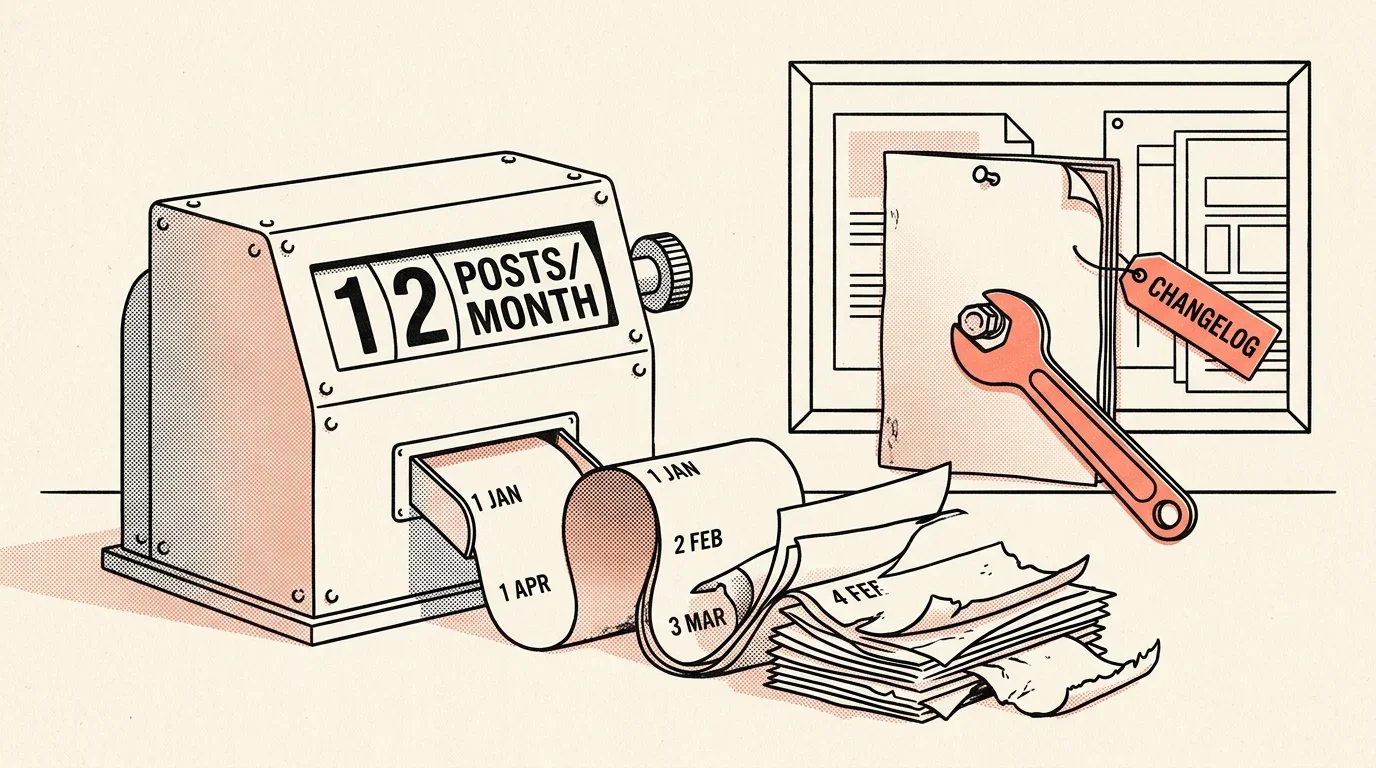
The AI answer that shaped last quarter's client brief has probably changed by now. The brief hasn't. Meanwhile the article it produced is live, the recommendation is marked closed, and the editor who made the call may already be on another account.
This is for agency content leads who answer for claims across several clients at once. Your AI visibility platform can flag that an answer moved. It can't tell you which approved sentence now rests on stale ground, which client legal team signed it off, or which person on your team should reopen the client brief and decide what happens next.
Here's the argument. Hand over the evidence record behind each decision, and give it a named owner who reopens it when its source or the AI answer changes. Scores and statuses go stale within a cycle. A record with an owner lets anyone answer the question in the title before a client asks it.
What does your next editor inherit?
Your next editor inherits a status and rarely a reason. The calendar says a recommendation was approved. Its sources sit in doc comments, a spreadsheet tab and a writer's personal notes, if they survive at all. So the successor can't tell when the decision should be challenged. That's the real risk, and it's far bigger than a slow handover.
Picture a normal handover on one of your accounts. An editor moves to a new client or leaves the agency. The new owner opens the content plan and finds a row marked approved and a live URL, while the chain that turned a market observation into a signed-off sentence lives nowhere they can reach.
You've probably tried to fix this. A source column in the content calendar holds up for a couple of months, then people stop filling it in when deadlines bite. A shared research folder per client keeps files tidy and connects no sentence to any source. Both fixes park evidence beside the work, in places nobody opens during review. So when legal asks where a number came from, someone spends an hour rebuilding a trail that once existed in a colleague's head.
So start with a rule you can paste into your process doc today. Every material claim in a client draft carries five things.
- The source URL and the exact passage that supports the claim.
- The date someone captured or last checked that passage.
- A named verifier who compared the wording with the passage.
- A named client approver.
- A named update owner who reopens the claim when its source or the related AI answer changes.
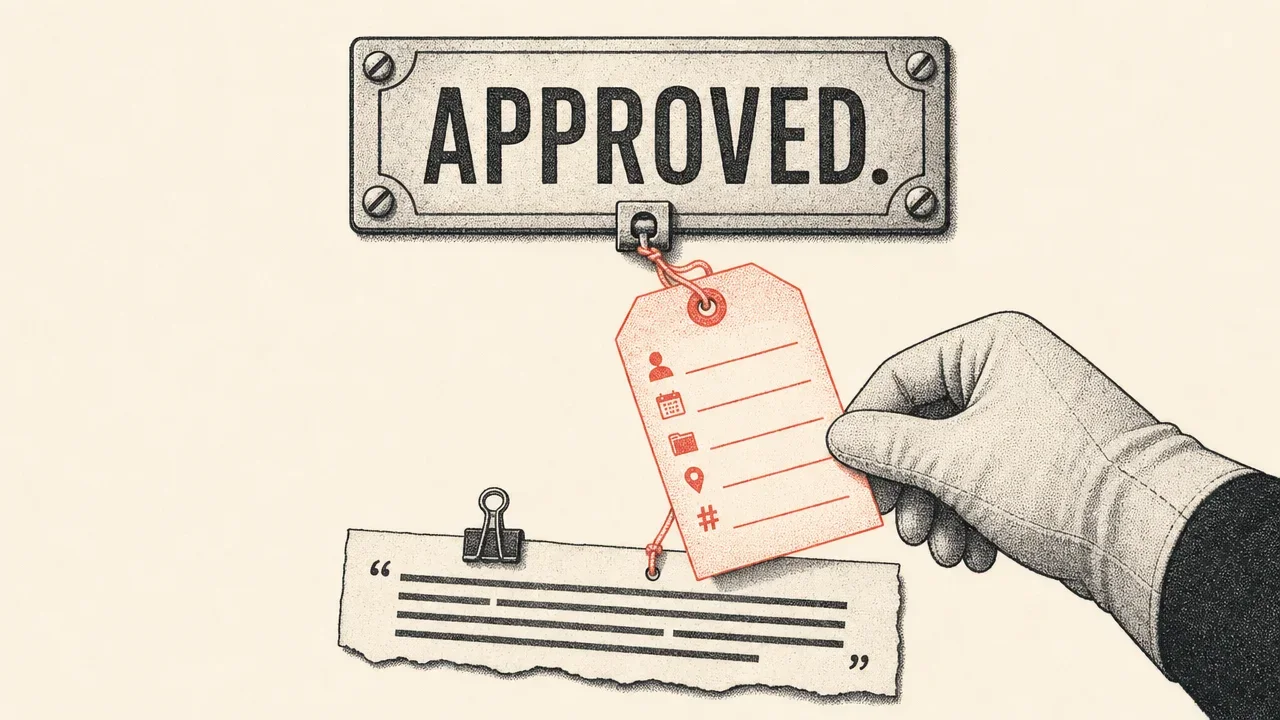
Put those five lines on the claimed sentence itself, as an anchored comment or linked note in whatever tool your team drafts in. When a writer edits or moves the sentence, the record moves with it and the edit shows up against it. After publishing, the record stays tied to the live wording, so the update owner opens the claim and its evidence together.
No passage, no claim. The sentence goes back to the writer or comes out. Everything else in this article explains why each line is there and what it costs.
Is the finding from your AI visibility platform still defensible?
A visibility finding is defensible only when someone can recover the prompt, engine, date, answer text and cited URLs behind it. Without those, you're asking legal to take a percentage in a client report on faith. AI answers move too often for faith to hold, and benchmarks refresh underneath you.
MarketScale's live B2B benchmark shows why. Across 394,120 tracked responses from five models, gathered between 23 June and 21 September 2026, about 24% named a tracked brand and about 17% linked to that brand's own content [1]. Roughly one response in four mentions a brand. Only one in six cites it. And the gap varies by engine. Gemini named a tracked brand in about a quarter of its answers but linked to that brand's content in fewer than one in eight, so find out whose pages those answers rest on [1].
MarketScale refreshes that report weekly, and it describes the sample as the projects it tracks, with results that shift by prompt, engine, location and time. A figure your team copied into a client brief in August may not match the live page today. Both readings can be accurate, drawn from different weeks and response sets. If the client brief doesn't name the week, your successor can't tell a revised sample from a changed market.
Clicks are a separate layer again. In browsing data Pew published in July 2025, people clicked a traditional result on 8% of Google visits that showed an AI summary, against 15% when no summary appeared. That's close to half the clicks gone. Links inside the summary drew a click on just 1% of those visits [2]. Report mentions, linked citations, AI-referred sessions and qualified leads as four separate series, because each one answers a different client question.
Then store every observation so the next editor can re-check it.
- The exact prompt, and whether it came from buyer language or a keyword hypothesis.
- The engine or model, locale and capture date.
- The full answer text, with the brands it named in order.
- Every cited URL, since a citation count alone gives a successor nothing to inspect.
- The run number, if you repeated the prompt.
Which buyer question warrants the next client brief?
The next client brief should answer a question your client's buyers ask, with proof they'll check after the AI shortlist. Treat your tracked prompts as a hypothesis about those questions. Label each prompt's origin, customer language or keyword inference, before it earns a client brief of its own.
Buyers do use AI early. In an Ipsos study published on 18 August 2026, 70% of 288 US B2B decision-makers said they use AI in vendor selection, and 42% use it to build an initial vendor list [3]. That's seven in ten using AI somewhere in the process, and about two in five letting it draft the first list. Ipsos used a purposive, unweighted sample, so read it as a direction of travel.
The same study shows buyers then turning to reviews, references, analysts and peers. One professional services executive said AI sped up research and shortlisting, “but I still rely on demos and implementation details to make the final decision.” That line should change how you plan. If a prompt surfaces worry about implementation risk, the client needs verified implementation detail on a page a buyer can open.
Gabriel Marketing Group, a B2B technology PR agency, shows the mechanism on its own account. It set a baseline for AI-answer mentions and citations, then revised its service, case study and pricing guidance pages and wrote a 10-part series mapped to the questions its buyers asked AI tools. Over 120 days it reports 830% more mentions, a 1,746% rise in domain citation rate across seven models and three qualified leads it attributes to AI discovery [4].
Read that result with care. GMG's earned media and thought leadership kept running during the same window, so nobody can say which change moved the numbers. What's worth copying is the chain of decisions. A buyer question exposed a weak answer, the team revised a proof page, and a fresh observation checked what happened.
That chain forces the real choice in every client brief. The cited URLs you stored show where the engine gets its view of the client. If it cites the client's own page and that page is thin, improving it is the right call. If it leans on review sites, analysts or competitors, the honest recommendation is independent validation through reviews, analyst coverage or earned media. Write down which call you made and why. Leave the uplift promises out of it.
Will the claim survive client approval?
A claim survives client approval when a named person has checked its wording against the exact source passage before the client sees it. A generic “human reviewed” status proves only that someone looked. Qualifications fall off claims in transit, and every handoff is a chance to lose one.
Sources drop out at four ordinary moments. Research becomes a client brief that quotes a statistic and drops the study period. A writer turns a qualified finding into an absolute. An account lead approves wording without opening the page behind it. Publishing keeps the final copy and loses the person who should update it.
Two standards from outside marketing set a useful bar. The Associated Press tells its staff that “any output from a generative AI tool should be treated as unvetted source material” [5]. US advertising guidance says advertisers should hold support for both express and implied claims before the ad runs, including the meanings a reasonable reader would take from it [6]. Plenty of blog sentences sit outside advertising law. Performance, product and comparison claims often sit close enough that a fintech or healthcare legal team will review them as if they were ads.
Here's a staged review with one owner per step. Each person checks one thing, and that keeps diligence from turning into a bottleneck.
| Stage | Owner | What they check | What sends it back |
|---|---|---|---|
| Research | Researcher | Attaches source URL, exact passage and capture date. Flags uncertainty. | A material claim with no passage |
| Draft edit | Editor, as verifier | Whether the wording says more than the passage supports | Absolute wording on a qualified finding |
| Account review | Account lead | Client-specific facts, product names and figures the client owns | Facts that conflict with the client's approved proof |
| Legal or compliance | Client's reviewer | Support for express and implied claims | Any claim they can't trace |
| Client approval | Authorised approver | Releases only the supported version | Open legal comments |
| After publishing | Update owner | Watches the source and the tracked AI answers | A source change or a repeated answer change |
This costs time at the front. Attaching a passage takes longer than pasting a link, and writers will feel it in the first week. The time comes back at legal review, where a traceable claim clears quickly and an untraceable one stalls the whole article while someone goes hunting. (Expect pushback anyway. Front-loaded work always looks slower on a status call.)
When should you reopen a closed recommendation?
Reopen a recommendation whenever its evidence moves, and let the update owner named in the record make that call. The editor then decides whether the older observation still warrants action. Calendar dates make poor triggers, because answers and sources change on their own schedule.
This only works if the handover gives a reviewable account of why each asset was approved. A calendar status records that something happened. The record explains why, and that tells the next person what would make the decision wrong. Write these reopen triggers into the record itself.
- The cited source is updated, retracted or returns a 404.
- A tracked answer changes the same way across several runs and engines, beyond one odd result.
- A benchmark you quoted refreshes and the new reading differs from the one on file.
- The client changes a product, price, claim or approved proof point.
Here's a live example. On Thursday 24 September, Google announced a global spam update, with a rollout that may take up to two weeks [7]. That announcement concerns Search ranking and says nothing about AI Overview citation rules. So annotate the window in client reporting and don't pin any shift in AI mentions on it. An update owner who reads the record knows which claims to watch through that fortnight.
Keep each client's records apart. You run several approval chains at once, each with its own legal reviewer, proof points and competitors, and evidence gathered for one fintech account should never surface in another client's draft, even when the tracked prompts overlap almost word for word. Separation also keeps the reopen decision clean, because the owner sees only the evidence that client approved.
When does an AI visibility platform earn its place?
An AI visibility platform earns its place when keeping comparable prompt histories by hand costs more than the tool, and when its findings can feed an accountable publishing workflow. For one or two clients with a stable question set, a manual log plus your SEO tools often does the job.
Manual checking has real strengths. You choose the prompts, you save the answers and you know exactly how each one was captured. Your existing SEO reporting still counts, too. The cracks show at scale, when repeat captures, cross-engine comparison and a clean weekly history all depend on one disciplined person who also has client deadlines.
A dedicated platform starts to pay once you're tracking several clients, several engines or locales, and running recurring competitive reports. Agency-focused tools advertise per-prompt tracking across engines and switching between client workspaces. Those are features. Judge the platform on the evidence it hands you over time, and ask for these before you sign.
- Raw exports of answers and every cited URL, grouped by domain, so you can see whether engines draw on the client's pages, competitors' pages or third-party sites.
- Dated snapshots that stay put when the dashboard refreshes.
- Repeat runs, so you can see noise before you call a trend.
- Strict separation between client workspaces.
- Cost per usable prompt, including the hours your team spends turning findings into decisions.
The last item is where buying decisions tend to go wrong. A tracker that produces charts nobody can act on still eats analyst hours every month. If a finding can't travel into a client brief, through review and onto a live page with an owner, the platform becomes one more tab your team reports from.
Can stronger governance guarantee an AI citation?
No. Governance can make a client's claim defensible and a handover recoverable. It can't make an engine cite a page. Keep those outcomes apart in every client conversation, because agencies that blur them end up promising placements they don't control.
Google's own guidance on AI features is blunt. A page needs normal indexing and snippet eligibility to appear as a supporting link, there's no special AI markup, and Google doesn't guarantee serving even for pages that qualify [8]. So why carry the overhead of a record that can't win the citation?
Because of what the record protects. It keeps a false claim away from a buyer who clicks through to check. Your team gets an answer in minutes when legal asks where a number came from. And a new editor can separate a real change from noise, so the next client brief responds to the market. A defensible handover guarantees accountability for the decision, and that's the outcome you can promise a client.
Before your next approval meeting, pick one client, one live article and its most consequential claim. Find the source passage, name the verifier and name the update owner. If that takes an hour, you've just measured what the current process costs you. Then paste the five-line rule into your process doc and run it on every new draft for a month.
An AI visibility platform tells you the answer moved. The record tells you who picks it up. If you'd like that record to live inside the workflow, Eclipse keeps each client in an isolated workspace where claims stay tied to their sources through planning, review, approval, publishing and the next client brief, and nothing goes live without human approval. Book a walkthrough and bring your messiest account.
This article offers general information about content operations and claim review. It isn't legal advice, so take substantiation questions to your client's counsel.
Our Opinion
Most teams will want to drop the fifth line, and it's the one we'd defend hardest. A verifier proves a sentence matched its source on the day it was approved. Only an update owner keeps it honest afterwards. We'd also tie verification to the wording itself. If an editor softens, sharpens or merges a claimed sentence after the check, the verification lapses and the claim goes back to the verifier before it reaches the account lead. That can feel fussy. It's also the only way to stop a qualifier vanishing from a sentence several people have already signed off.
The mistake we'd warn against is buying AI visibility tools to produce better charts, when the harder problem is what happens to a finding after the chart. A percentage with no dated prompt, engine or answer text behind it is the same untraceable claim legal already sends back, just dressed as reporting. So we'd hold client reports to the same standard as client drafts. No visibility figure goes to a client without its capture record attached. If that means fewer numbers in the monthly report, send fewer numbers.
About the Author
Mark Ridgeon is the founder of Eclipse, the B2B content operating system for companies and content marketing agencies. Alongside it, he takes on fractional COO work through ridgeon.me, which keeps him close to the everyday mess of handovers, approvals and scattered evidence. He writes about evidence-led go-to-market content, client-scoped workflows and keeping every claim tied to proof from research through publish.
References
- The State of GEO: AI Visibility for B2B Companies. MarketScale.
- Do people click on links in Google AI summaries? Pew Research Center.
- 2026 B2B Buyer Journey. Ipsos.
- Gabriel Marketing Group Wins Gold for Best AEO Results. Gabriel Marketing Group.
- Standards around generative AI. The Associated Press.
- Advertising substantiation. Federal Trade Commission.
- Incident details. Google Search Status Dashboard.
- AI Features and Your Website. Google Search Central Documentation, Google for Developers.